

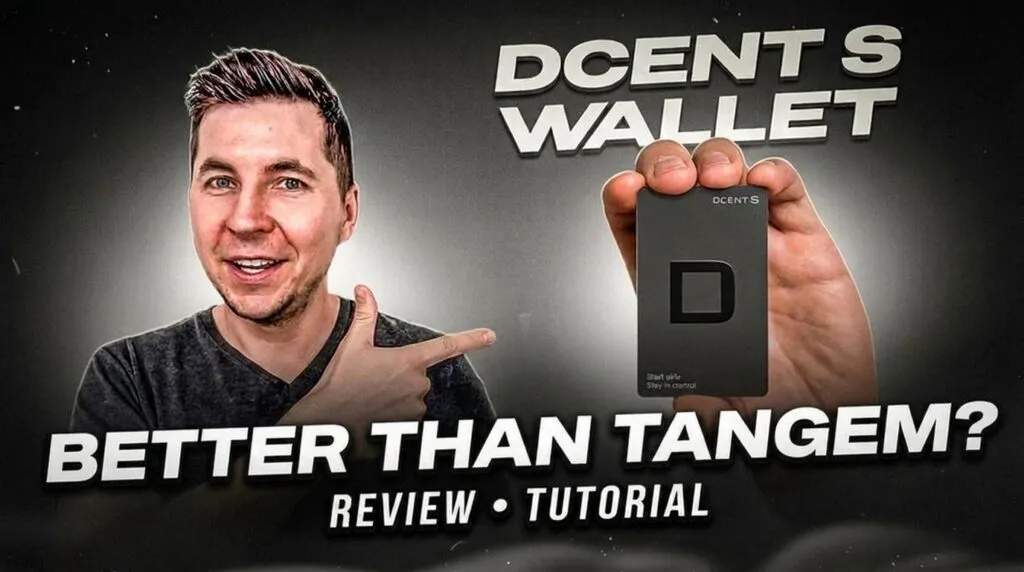
The D’CENT S is a credit card-sized NFC cold wallet made by IoTrust, and it launched in July 2025 as one of the most thoughtfully designed card wallets on the market. At around $44 USD (discounted from $59), it includes two cards in the box — a signing card and a dedicated recovery card — which changes the backup equation entirely compared to everything else in this price range. If you’ve been putting off getting a hardware wallet because you’re worried about losing your seed phrase or dealing with a clunky setup, this wallet was designed specifically to solve both of those problems.
Let me share my findings and review for the D’CENT S wallet.
-

-
Pros & Cons
- EAL6+ Certified Secure Element
- Dedicated Non-Signing R3covery Card Included
- Credit Card Size — Fits in Any Wallet
- No Battery, No Cable, No Bluetooth (NFC Only)
- IP69 Rated — Water and Dust Resistant
- 100+ Networks and 4,900+ Tokens
- Strong XRP Support Including Trust Lines
- Built-In Swap via Squid (100+ Chains in One Transaction)
- Hardware True Random Number Generator
- Made by IoTrust — Active Since 2018
- No On-Device Screen (Phone Screen Used for Transaction Verification)
- Requires NFC-Capable Phone
- Card Must Be Physically Present for Every Transaction
- 1-Year Warranty
- Limited Desktop Use Without a Separate NFC Reader
-
Fees
$59
-
Coins
100+ Networks and 4,900+ Tokens

EAL6+ Certified Secure Element
The D’CENT S uses an EAL6+ certified secure element to generate and store your private keys. EAL6+ is the same security grade found in biometric passports and banking smart cards — it’s the highest level you’ll find in consumer hardware wallets. Your keys are created inside that chip during setup and they never leave it. Not when you tap to sign a transaction, not during an app update, not ever. IoTrust has been building secure element wallets since 2018 and the S model continues that standard.
Dedicated Non-Signing R3covery Card — The Real Differentiator
This is what makes the D’CENT S worth paying attention to.
Most card wallets make you choose between two bad options. You either write down a seed phrase on paper — which people lose, photograph by accident, or store insecurely — or you buy two or three identical cards, which means you now own multiple devices that can all spend your money. Lose one to a thief and it’s over.
D’CENT ships with a second card called the R3covery card. It’s an encrypted backup of your wallet that is physically incapable of signing transactions. A thief who gets hold of it cannot move a single coin. It can only be used to restore your wallet onto a new D’CENT S card. If your main card is lost or damaged, you tap the R3covery card to a new one and you’re restored in minutes.
That’s a genuinely smarter design. The backup is useless to someone who wants to steal from you, but it’s fully functional for disaster recovery. You can still generate a traditional seed phrase if you prefer that route — seedless setup is optional, not forced.
Store the R3covery card somewhere separate from your signing card. Not the same wallet, not the same drawer. Treat it like a spare key to your house.
Credit Card Form Factor — Fits Where Other Wallets Don’t
At 85.6 by 54 millimetres and 0.9 millimetres thick, the D’CENT S is exactly the size of a standard credit card and thinner than most. It slots into your regular card wallet next to your Visa and your transit card. There is no battery, no USB cable, no Bluetooth antenna, no charging ritual. You tap it to your phone and NFC powers the card to sign the transaction. When you pull it away the card goes completely inert.
For Canadians, the IP69 water and dust resistance is more than a box-tick spec. The card works from minus 30 to plus 50 degrees Celsius. That minus 30 rating is real-world useful if you live in Edmonton, Winnipeg, or anywhere else in Canada where January is a serious thing.
Hardware True Random Number Generator
Private keys on the D’CENT S are created using a hardware-based true random number generator built into the secure element. This matters more than it sounds. In late July 2025, a serious flaw was disclosed in a competing hardware wallet where a firmware error caused the device to bypass its hardware RNG when generating seeds, making those seeds guessable. Hundreds of wallets were drained within half an hour.
D’CENT’s key generation happens fully offline inside the certified chip, using full 256-bit entropy at BIP39 standard, on a hardware RNG that has no connection to firmware logic. IoTrust has maintained a clean security record across their product line since 2018.
100+ Networks, 4,900+ Tokens, and Strong XRP Support
Bitcoin, Ethereum, all major EVM chains, Stellar, and XRP are all covered. The XRP support specifically is worth calling out — the D’CENT S handles XRP Trust Lines natively, which most card wallets either skip or implement poorly. If you hold XRP or interact with XRPL-based assets like RLUSD, this wallet is one of the better options available at any price.
Total network count sits above 100 with over 4,900 supported tokens. That covers the vast majority of portfolios without needing a second device.
Built-In Swap via Squid
The D’CENT app includes a swap function powered by Squid that lets you move assets across more than 100 chains in a single transaction. So if you want to convert USDC on Ethereum directly into XRP, you can do that without manually bridging, without leaving the app, and without setting up a separate DEX account. Staking is also available through dApps — XRPL staking through SOIL and XRP staking through Flare are both accessible directly from the app.
Cons
No On-Device Screen
This is the most significant tradeoff and you should understand it before buying. The D’CENT S has no screen. When you’re approving a transaction, you’re reading the details on your phone inside the app, not on the wallet itself. That means if your phone were compromised, you could theoretically be shown transaction details that don’t match what actually gets signed. Traditional hardware wallets with their own screens — Trezor, Ledger — let you verify on the device itself.
D’CENT includes Blockaid integration in the app for phishing detection and transaction simulation, which meaningfully reduces this risk in practice. But it’s not the same architecture as an independent display, and you should know that going in.
Requires NFC-Capable Phone
No NFC, no wallet. Most phones made in the last five years have NFC built in, but check yours before ordering. Desktop use requires purchasing a separate NFC reader since the card can’t connect via USB.
Card Must Be Present for Every Transaction
Every single transaction requires the physical card. Leave it at home and you can’t move funds. For some people that’s the whole point — it makes unauthorized transactions much harder. For others it’s friction. Know which camp you’re in.
1-Year Warranty
IoTrust covers the D’CENT S for one year. That’s a shorter coverage period than some competitors offer. The card itself is rated for long-term durability given the secure element build quality, but the warranty is worth factoring in if longevity coverage matters to you.
D’CENT S vs Tangem — How They Compare
These two wallets compete directly. Both are NFC card wallets with no screen and secure element chips. Here’s where they differ in practice:
D’CENT S advantages:
- The R3covery card system solves the backup problem more elegantly than buying duplicate signing cards. Your recovery card cannot spend funds — Tangem’s backup cards can.
- EAL6+ secure element vs Tangem’s EAL6+ (comparable on chip grade)
- Higher network count — 100+ networks vs Tangem’s current coverage
- Stronger XRP and Trust Lines support
- Built-in cross-chain swap via Squid
Tangem advantages:
- Larger product ecosystem including the Tangem Ring and other form factors
- 25-year warranty vs D’CENT’s 1 year
- Longer time in market and more accumulated user reviews
- More form factor options
The backup system is the core decision point. If the idea of owning multiple cards that can all authorize transactions makes you uncomfortable, D’CENT’s approach is meaningfully better. If ecosystem maturity and warranty length matter more, Tangem is the stronger choice there. Neither wallet is objectively better — they reflect different design priorities.
My Personal Opinion
The D’CENT S gets the fundamentals right in a way that is easy to overlook at first glance. The $44 launch price for two cards sounds almost too cheap until you realize that the second card is a purpose-built recovery device and not just a copy of the first one. That distinction is the entire product.
The R3covery card design is the most practical answer I’ve seen to the backup problem that has kept a lot of people away from hardware wallets. Seed phrases get photographed, lost, or stored somewhere that makes sense right now and makes no sense three years from now. Having a physical backup that can’t be used to steal from you, but can restore everything in minutes, is the right architecture for most people.
IoTrust has been building hardware wallets since 2018. The platform is not new, the S model is the newest form factor in their lineup, and the underlying security infrastructure has a clean track record.
My Recommendation:
For beginners getting their first hardware wallet: The two to three minute setup, seedless backup, and mobile-first design make this one of the easiest hardware wallets to get started with. There is no seed phrase ritual if you don’t want one.
For people who want everyday carry cold storage: Credit card size, no battery, NFC tap-to-sign. This is what that category should look like.
For XRP holders specifically: The Trust Lines support and XRPL staking access through the app make this one of the better dedicated options for XRP-heavy portfolios at any price.
For large long-term cold storage: Consider whether you want an on-device screen for independent transaction verification. If you do, a Trezor or Ledger is the right call. If mobile-first UX and the R3covery backup system are the priority, the D’CENT S handles serious amounts reliably.
At $44 USD for both cards, it’s one of the strongest entries in the card wallet category.
Disclaimer: This review does not constitute financial, tax, or legal advice in any way whatsoever but for information purposes only. When making financial and legal decisions and commitments, we strongly recommend you consult your professional financial and legal services providers.