

Status Notice: Bitfinex is an offshore exchange run by iFinex Inc. It is not CSA-registered as far as I can find, a search of the FINTRAC registry on October 2, 2026 returned no Bitfinex or iFinex entry, and Bitfinex stopped serving Ontario customers on March 1, 2022. Its Securities restrictions article also lists Canadian persons as prohibited. Whether it accepts you depends on where you live, so check its current terms and your province before doing anything. This review is kept for reference. For a platform that is registered and serves every province, start with Coinbase (open an account).
Bitfinex is one of the oldest crypto exchanges, founded in 2012, and a sister company of Tether. Its official fee page now shows zero maker and taker fees on spot, margin, derivatives and eligible Securities products, which is the lowest trading cost I have seen. The catch for Canadians is access and protection: Ontario customers were cut off in 2022, there is no Canadian registration, no Interac, and the platform carries a documented 2016 hack and a 2021 New York settlement. It suits experienced traders outside Ontario who fund with crypto and keep only trading balances there.
Offshore Not registered with the Canadian Securities Administrators as far as I can find, no FINTRAC MSB entry, and Ontario customers have been shut out since March 1, 2022. No Canadian investor protection applies. It only suits experienced traders outside Ontario who fund with crypto and accept the offshore risk.
| Detail | Info |
|---|---|
| Founded | 2012. Operated by iFinex Inc. |
| Canadian Registration | Not on a registry I could find: no FINTRAC entry for Bitfinex or iFinex in the registry file searched October 2, 2026, and not a CIRO member |
| Ontario | Bitfinex stopped letting Ontario customers open accounts on October 21, 2021 and ended all Ontario services on March 1, 2022, per its support article |
| Spot And Margin Fees | Zero maker and taker fees (official fee page) |
| Derivatives Fees | Zero maker and taker fees (official fee page) |
| Fees That Remain | Lending fees, withdrawal fees and other fees are unchanged (official zero-fee page) |
| Fiat Deposit, Bank Wire USD Or EUR | 0.100%, minimum 60 (USD or EUR) |
| Fiat Withdrawal, Bank Wire USD Or EUR | 0.100%, minimum 100 (USD or EUR). Express wire 1.000%, minimum 125 |
| Fiat Via OpenPayd (EUR Or GBP) | 5 EUR or GBP per transaction up to 10,000, then 0.100% |
| Crypto Deposits | Free |
| CAD Funding | No Interac e-Transfer |
| Past Incident | August 2016 hack of 119,756 BTC; sentences handed down in 2024 |
| New York | Barred from serving New York residents after the 2021 NYAG settlement |
| My Ranking | Outside my top ten. I no longer give it a score |
Is Bitfinex Safe For Canadians In 2026?
Bitfinex is a real, operating exchange with a long history, but it comes with a documented security breach and a settlement with the New York Attorney General that cannot be left out of any honest review. It is not registered in Canada, so no Canadian regulator oversees your holdings, and the 2016 breach is relevant to any risk assessment.
The 2016 breach is worth understanding fully. In August 2016, a hacker (later identified as Ilya Lichtenstein) exploited Bitfinex's multi-signature wallet system via a compromised BitGo API key and transferred 119,756 BTC to a wallet he controlled. At the time, the Bitcoin was worth approximately $72 million. In compensation, Bitfinex issued BFX tokens that could be redeemed for cash or converted into iFinex equity shares. By April 2017, all BFX tokens had been redeemed at face value. The DoJ arrested Lichtenstein and his wife Heather Morgan in February 2022 after tracking the laundering chain. The government recovered over 94,000 of the stolen BTC worth about $3.6 billion at the time of seizure. Lichtenstein was sentenced to five years in prison in November 2024. Morgan received 18 months.
The NYAG settlement context: in 2021, iFinex paid $18.5M to settle an NYAG investigation into whether Bitfinex had used Tether reserves to cover an $850M shortfall in Bitfinex funds. iFinex admitted no wrongdoing. The settlement also barred Bitfinex from serving New York residents. Canadians outside New York are not directly affected by this settlement but the underlying story of Tether-Bitfinex interconnection and the NYAG's concerns about reserve disclosures is part of the Bitfinex risk picture that any informed Canadian user should understand.
The Proof of Reserves point from my old review stands as a caution rather than a number: I could not verify any current reserve audit from an official page, so I do not claim one. Compared to the on-chain reserve reports some competitors publish, check what Bitfinex currently offers before you trust it with more than trading money.
What Is Bitfinex's Track Record?
Founded in 2012, Bitfinex is one of the oldest major exchanges still operating, alongside Kraken and Bitstamp. It has operated through China's 2017 ban, the 2018 to 2019 bear market, the 2022 collapse of FTX, Celsius and Three Arrows Capital, and the regulatory wave since. It pioneered features that are now standard, including margin trading and advanced order types. The table covers the dated events I can source.
| Date | Milestone |
|---|---|
| 2012 | Founded. One of the first exchanges to offer advanced order types and margin trading |
| August 2016 | 119,756 BTC stolen in a hack. Losses were spread across account holders and compensated with BFX tokens |
| February 2021 | New York Attorney General settlement: iFinex and Tether pay $18.5 million, admit no wrongdoing, and Bitfinex stops serving New York residents |
| October 21, 2021 | Bitfinex blocks new Ontario account openings |
| March 1, 2022 | Ontario customers lose access to Bitfinex services |
| February 2022 | US authorities arrest Ilya Lichtenstein and Heather Morgan over laundering of the stolen bitcoin |
| November 2024 | Lichtenstein sentenced to five years, Morgan to 18 months |
| December 2025 | Bitfinex moves to zero maker and taker trading fees |
How Do Canadians Fund A Bitfinex Account?
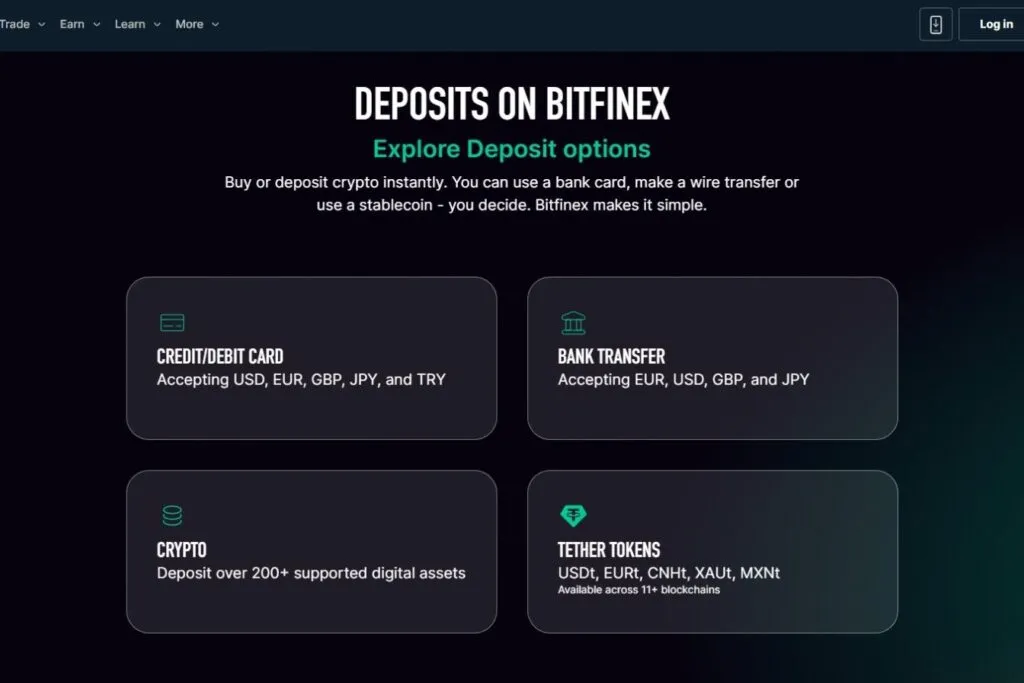
There is no Interac e-Transfer. Bitfinex's fee page lists bank wires in USD or EUR at 0.100% with a minimum of 60 USD or EUR on deposit and 100 on withdrawal, an express 24-hour withdrawal wire at 1.000% with a minimum of 125, and OpenPayd transfers in EUR or GBP at a flat 5 per transaction up to 10,000. Crypto deposits are free and are the method most Canadian traders use.
Wire Transfer
The fee page prices wires in USD and EUR, not CAD, so a Canadian wire from a CAD account means a currency conversion at your bank. With a minimum fee of 60, wires only make sense for large deposits, and some Canadian banks ask for extra verification on international wires to offshore entities. Settlement typically takes one to three business days.
Crypto Transfer From A Canadian Exchange
Buy Bitcoin or another coin on a regulated Canadian exchange via Interac, then withdraw to your Bitfinex wallet address. Crypto deposits to Bitfinex are free. Pick the cheapest network for the coin, and send a small test amount first. This two-step route avoids the wire fee and is the standard workflow for Canadian active traders.
Cashing Out To CAD
The simplest way back to CAD is to withdraw a coin to a regulated Canadian exchange, sell it for CAD and withdraw by Interac. A direct wire withdrawal in USD or EUR means your bank does the conversion. Confirm the denomination and fees with Bitfinex support and your bank before moving a large amount.
What Does The Zero-Fee Model Mean For Canadians?
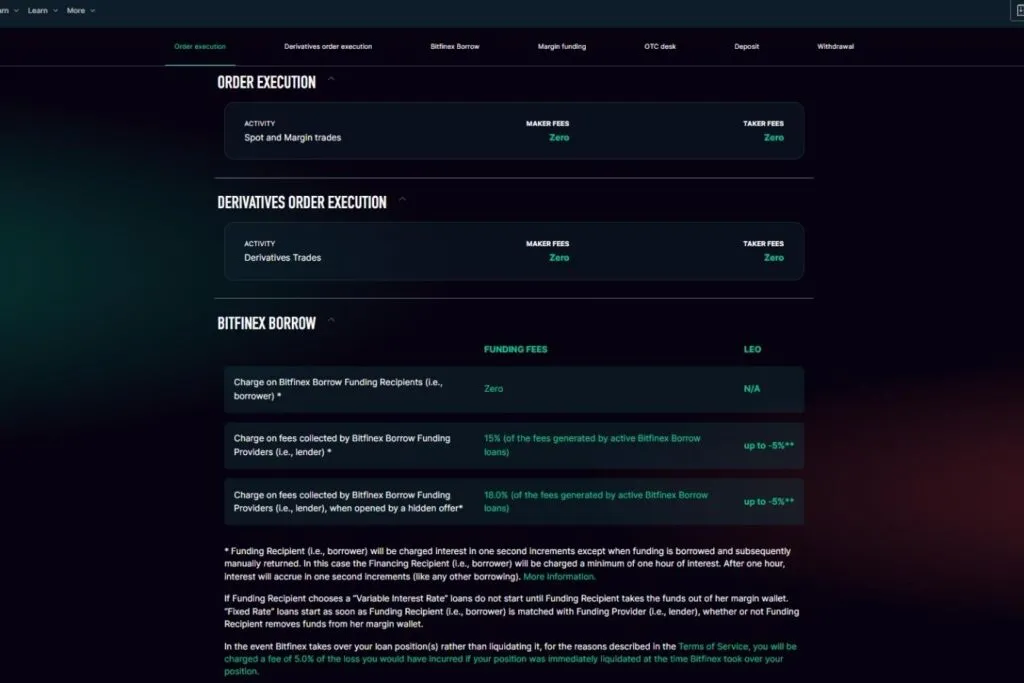
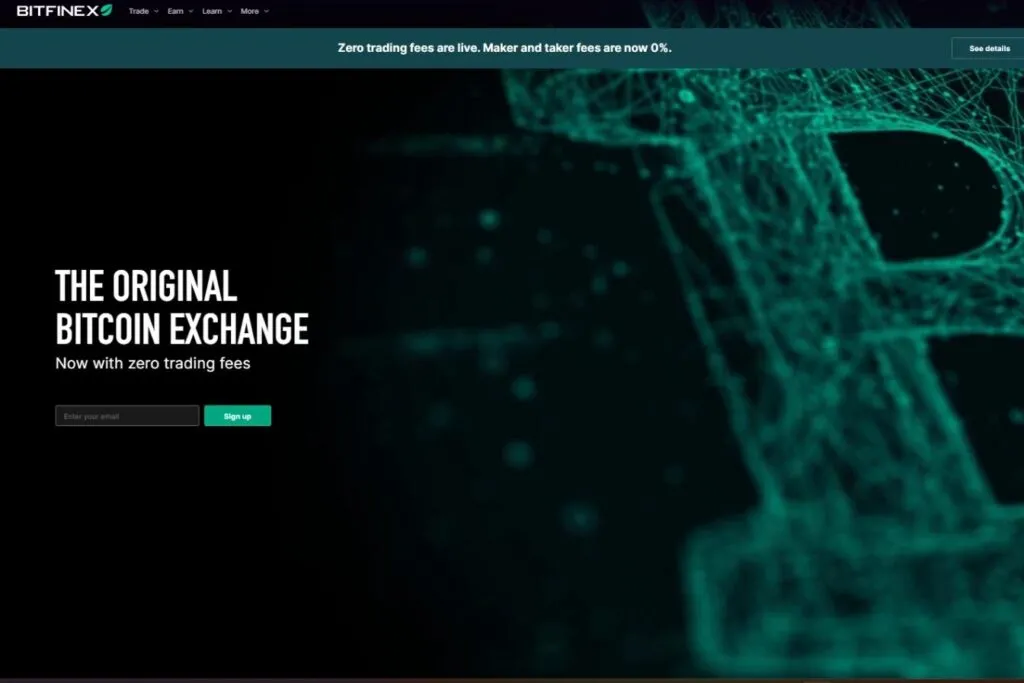
Bitfinex's zero-fee trading page says all customers get zero maker and taker fees on spot and margin trading, Bitfinex Derivatives, eligible Bitfinex Securities products and OTC block trades. There are no volume requirements, no token holdings and no tier conditions, and Bitfinex calls the lowering to zero an ongoing change that becomes the new standard. The page is explicit that all other fees, such as lending fees and withdrawal fees, remain unchanged.
The practical effect for Canadians is real. For large trades on liquid pairs, a zero trading fee makes Bitfinex one of the cheapest places to execute, and the only costs left for someone funding by crypto transfer are the withdrawal fee from their Canadian exchange and the network fee on anything they withdraw from Bitfinex.
The company has said it makes money elsewhere, through lending, withdrawal fees and the wider iFinex business, which includes Tether. One important caveat: margin lending is not free. If you borrow from the peer-to-peer lending market to use margin, you pay the going rate set by lenders. Trading the borrowed position is free; borrowing itself has a market-set cost.
What Features Does Bitfinex Offer In 2026?

Bitfinex is a professional trading platform: spot and margin markets, perpetual derivatives, a peer-to-peer lending market, Bitfinex Securities, advanced order types, a full API and a paper trading mode. It is not for beginners.
Advanced Order Types
Bitfinex offers limit, market, stop, trailing stop, fill-or-kill, and iceberg orders as standard. The scaled order feature is particularly useful for active traders: set a price range and quantity, and the exchange auto-distributes the order across multiple limit levels. This is the built-in equivalent of a DCA entry strategy without manually placing dozens of orders. OCO (one-cancels-other) allows setting a take-profit and stop-loss simultaneously on the same position, with the unfilled order cancelled when one executes.
Margin Trading And P2P Lending Marketplace
Margin trading is available on supported spot pairs. Borrowed funds come from the P2P lending marketplace, where Bitfinex users lend their idle crypto directly to margin traders at rates set by real supply and demand. This is different from exchange-controlled lending: rates fluctuate daily based on the available supply of lenders and the demand from borrowers. For Canadians who want to earn yield on idle BTC, ETH, or USDT, the P2P lending market offers a genuinely interesting passive income option with daily interest payments. Lending rates are variable and can be high during periods of elevated margin demand. Note that lending crypto to margin traders carries counterparty risk: Bitfinex's margin system has risk controls but an extreme market event could theoretically result in losses for lenders if the system cannot liquidate positions fast enough.
Perpetual Derivatives
Bitfinex runs a perpetual derivatives platform with leverage, and its official fee page lists zero maker and taker fees on derivatives. I have dropped the contract count, the collateral details and the BloFin and Bitunix fee comparisons from my old text because I could not verify them from an official page. Derivatives with leverage are not offered to Canadian retail clients on any registered platform, which is why Canadians look offshore, and high leverage amplifies losses as readily as gains.
Bitfinex Securities
Bitfinex Securities is the exchange's arm for tokenized real-world assets, and Bitfinex lists eligible Securities products among those with zero trading fees. It is an early-stage product, and its own Securities restrictions article lists Canadian persons as prohibited persons. Treat it as not available to you unless Bitfinex confirms otherwise in writing.
Bitrefill Integration
Convert BTC, ETH, USDT, or other holdings to gift cards without leaving the Bitfinex interface. For Canadians who want to use crypto for everyday purchases without converting to CAD and paying banking fees, this is a practical utility most exchanges do not offer.
API Access
Full REST and WebSocket APIs for automated trading, data feeds, and institutional integration. For Canadian algorithmic traders or developers building trading tools, this is a meaningful technical advantage over smaller offshore exchanges with limited or underdocumented APIs.
How Does Bitfinex Compare With Other Exchanges Available To Canadians?
Zero trading fees make Bitfinex the cheapest to trade on my list, and the weaknesses are the ones above: no Canadian registration, no Interac, an Ontario shutout and the incident history. This table uses only verified figures from my 2026 fact file.
| Exchange | Spot Fee | Canadian Status | CAD Funding |
|---|---|---|---|
| Bitfinex | 0% maker and taker | Offshore, Ontario excluded | No Interac; USD or EUR wire |
| BloFin | 0.1% spot | Offshore, terms prohibit Canada | No CAD funding |
| MEXC | 0% maker, 0.05% taker | Offshore, terms prohibit Canada | No CAD funding verified |
| NDAX | 0.20% flat | CSA-registered | Free Interac e-Transfer and wire |
| Kraken | Pro 0.40% maker, 0.80% taker | CSA-registered | Free Interac e-Transfer deposits |
What Are The Biggest Complaints About Bitfinex?
Beyond the 2016 hack, the main complaints are the complexity of the interface for non-professionals, the lack of Interac, the Ontario shutout, and the Tether relationship with the New York settlement.
Interface Complexity
Bitfinex's trading interface is designed for professionals. It is fully customizable (drag and drop every element including charts, order book, positions, and history), supports multiple colour schemes, and includes features like the spread ladder that have no equivalent on simpler platforms. Before depositing real money, spend time in the paper trading mode. The interface is genuinely excellent once learned but is not designed to be immediately intuitive to a retail newcomer.
No Interac And Wire-Only Access
The absence of Interac e-Transfer is the most practical limitation for Canadian retail users. Wire transfers to international banks mean going through your bank's international wire process, providing SWIFT codes, waiting a few days, and paying a minimum fee of 60. Most Canadian users skip it by funding from a regulated Canadian exchange. For a Canadian who wants a simple CAD deposit path, Bitfinex is not the right platform.
Tether Relationship And NYAG Settlement
iFinex operates both Bitfinex and Tether. The same CEO (Paolo Ardoino) runs both companies. The 2021 NYAG settlement arose from an investigation into whether Bitfinex used Tether reserves to cover an $850M shortfall from a payment processor (Crypto Capital Corp.) that froze Bitfinex funds. The NYAG found that iFinex's public representations about Tether reserve backing were misleading. iFinex paid $18.5M and admitted no wrongdoing. This history is relevant because USDT is the primary trading currency on Bitfinex's platform. Users who have concerns about the underlying backing of USDT should consider this relationship when assessing Bitfinex as a platform.
Reserve Transparency
I could not verify a formal, audited proof of reserves for Bitfinex from an official page. After FTX, a published, verifiable reserve report has become the minimum transparency standard for major exchanges, so keep only trading balances here.
Scam Awareness
Bitfinex impersonators are active on Telegram and social media offering recovery services or exclusive trading groups. Bitfinex does not operate unsolicited Telegram investment groups. Access Bitfinex only through bitfinex.com directly. See our guide on common crypto scams in Canada.
Who Should Use Bitfinex, And Who Shouldn't?
Bitfinex is built for experienced traders who want deep markets, advanced order types and zero trading fees, who live outside Ontario, and who fund by crypto transfer. It is not appropriate for beginners, anyone who needs Interac, or anyone for whom the 2016 hack and the Tether relationship are disqualifying.
Bitfinex Is A Good Fit If You:
- Are an experienced trader who wants deep liquidity on major pairs for large orders
- Want zero maker and taker trading fees, with no volume tiers or token requirements
- Want to earn yield on idle crypto through the peer-to-peer lending market without giving it to an exchange staking product
- Use or plan to use the REST and WebSocket API for automated strategies
- Fund via crypto transfer from a regulated Canadian exchange
- Live outside Ontario and accept the 2016 hack and the Tether relationship as part of the risk profile
Bitfinex Is Not The Right Choice If You:
- Live in Ontario, where Bitfinex has not served customers since March 1, 2022
- Need Interac e-Transfer. Use NDAX, Kraken or Coinbase
- Are buying crypto for the first time or are uncomfortable with professional interfaces
- Want Canadian regulatory protection. Use a CSA-registered platform
- Are concerned about the Tether and Bitfinex relationship or the New York settlement history
What Are The Pros And Cons Of Bitfinex?
Pros
- Zero maker and taker trading fees on spot, margin, derivatives and eligible Securities products
- One of the oldest exchanges still operating, founded in 2012
- Professional order types, full API and a paper trading mode
- Peer-to-peer lending market that sets funding rates by supply and demand
- Free crypto deposits
Cons
- Not registered in Canada, and Ontario customers have been excluded since March 1, 2022
- No Interac e-Transfer; bank wires cost 0.1% with a minimum of 60
- The 2016 hack and the 2021 New York settlement
- Interface built for professionals, steep for beginners
- Lending, withdrawal and other fees remain
What Are Better Options Than Bitfinex For Canadians?
| Exchange | Score | Canadian Status | Fees | CAD Funding |
|---|---|---|---|---|
| Coinbase | 9.8 | CSA-registered (Restricted Dealer) | Up to 1.875% on simple buys, plus spread | Free Interac e-Transfer and EFT |
| Kraken | 9.2 | CSA-registered (Restricted Dealer) | Kraken Pro 0.40% maker / 0.80% taker; Instant Buy 1% | Free Interac e-Transfer deposits |
| Wealthsimple Crypto | 8.4 | CSA-registered, CIRO investment dealer | 0.5% plus spread | Free Interac e-Transfer |
| Newton | 7.9 | CSA-registered, CIRO investment dealer | No fee; spread from 1.00% on BTC | Free Interac e-Transfer, wire and EFT |
| NDAX | 7.8 | CSA-registered, CIRO investment dealer | Flat 0.20% | Free Interac e-Transfer and wire |
See the full best crypto exchanges for Canadians ranking, or take the exchange quiz. Questions go to r/OCryptoCanada.
Is Bitfinex Worth It For Canadians In 2026?
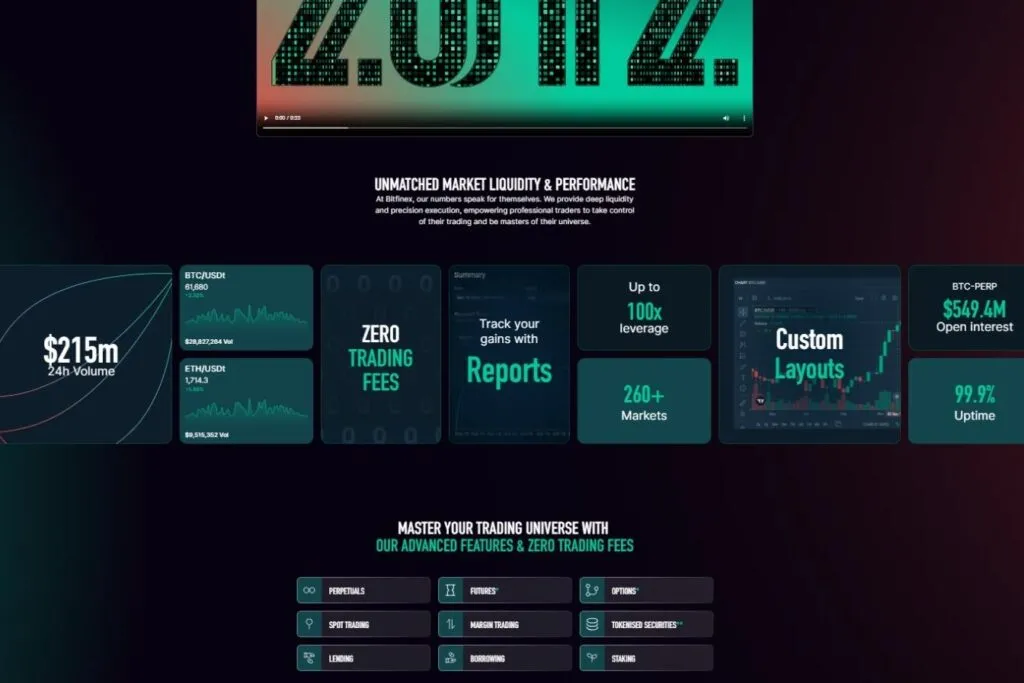
Bitfinex today is a different platform from the one that was hacked in 2016, and its December 2025 move to zero trading fees is the biggest fee change I have seen at a major exchange. Combined with deep markets and a full set of professional tools, it is a compelling venue for serious traders.
The risk picture has not changed because fees went to zero. The 2016 hack happened. The New York settlement happened. There is no Canadian registration, no Interac, and Ontario customers have been excluded since 2022. The iFinex and Tether relationship remains a concentration-of-power concern. Weigh all of that against the real strengths.
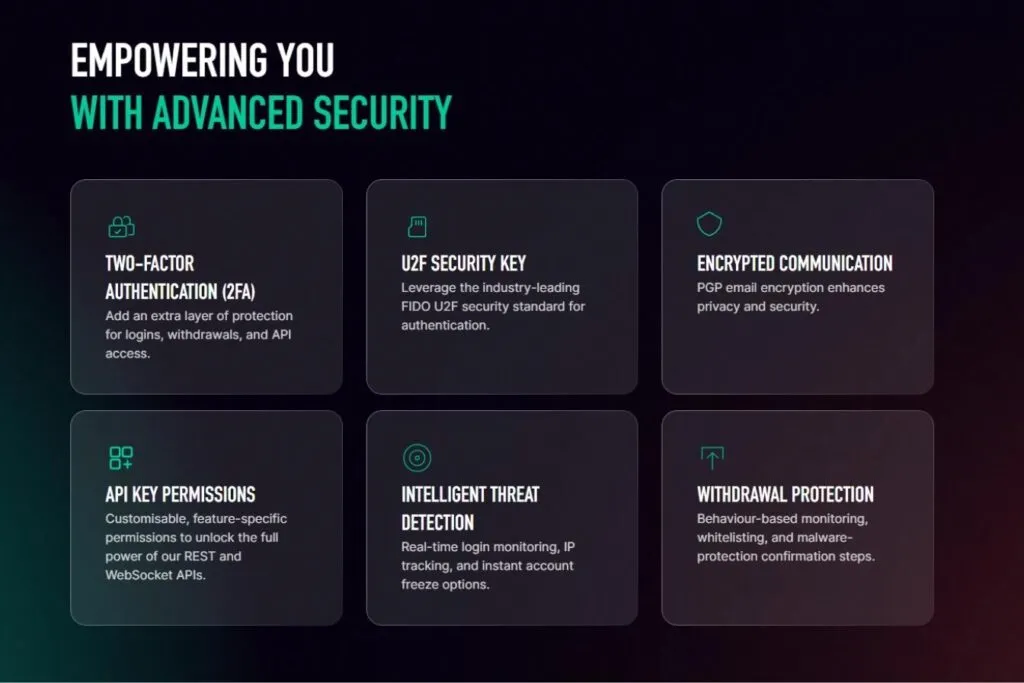
My recommendation: if you are experienced, live outside Ontario and want a trading venue, fund it by crypto transfer from a regulated Canadian exchange, switch on 2FA and withdrawal whitelisting, and treat it as a place to trade, not to store. Keep long-term holdings in a hardware wallet or at a regulated Canadian exchange, and withdraw profits regularly. Take our exchange quiz if you are unsure.
What Changed For Bitfinex In October 2026?
- Ilya Lichtenstein, sentenced in 2024 over the 2016 Bitfinex hack, was reported released early under the US First Step Act.
- Bitfinex moved to zero maker and taker trading fees, which its official page calls an ongoing change.
- Lichtenstein was sentenced to five years and Morgan to 18 months in the US.
- Ontario customers lost access to Bitfinex services.
Frequently Asked Questions
Is Bitfinex Safe For Canadians?
Bitfinex has operated since 2012, but it suffered a 2016 hack of 119,756 BTC and paid $18.5 million in a 2021 New York settlement with no admission of wrongdoing. It is not registered in Canada, so no Canadian regulator oversees your holdings.
Does Bitfinex Have Zero Trading Fees?
Yes. Its official page says all customers get zero maker and taker fees on spot and margin, derivatives, eligible Securities products and OTC block trades, with no volume or token requirements. Lending fees, withdrawal fees and other fees remain.
Can Canadians Use Bitfinex?
Ontario customers have been blocked since March 1, 2022, and Bitfinex Securities lists Canadian persons as prohibited. Check Bitfinex's current terms for your province before signing up.
Can Canadians Deposit CAD On Bitfinex?
There is no Interac e-Transfer. The official fee page lists bank wires in USD or EUR at 0.100% with a minimum of 60, so a CAD wire means a bank conversion. Most Canadians fund with crypto sent from a regulated exchange.
What Was The Bitfinex Hack?
In August 2016 an attacker stole 119,756 BTC. Ilya Lichtenstein was sentenced to five years in November 2024 and Heather Morgan to 18 months for laundering the proceeds.
What Is The Difference Between Bitfinex And Tether?
Both are run by iFinex Inc. Tether issues USDT, and Bitfinex is a trading platform. The 2021 New York settlement came from an investigation into whether Bitfinex used Tether reserves to cover a shortfall.