

MEXC is a Seychelles-based offshore exchange with a 0% maker and 0.05% taker spot fee and about 1,425 tradable spot coins, far more than any registered Canadian platform. It is also, officially, off limits to Canadians: its User Agreement names Canada as a prohibited jurisdiction, it is not on the CSA's authorized list, and several provincial regulators have cautioned against it. I score it 7.0 out of 10 for features and fees, with big caveats for anyone in Canada.

- Best ForExperienced traders hunting small-cap altcoins
- Trading Fee0% maker / 0.05% taker
- CAD FundingNo CAD funding verified
- Coins1,400+ spot assets
- App Store (Canada)4.7 / 5 from 1,908 ratings
- Google Play4.6 / 5 from 313K reviews
Offshore Not registered with the Canadian Securities Administrators, and its terms of service restrict Canadian residents. No Canadian investor protection applies. It still suits experienced traders who specifically need altcoins no registered Canadian platform lists and who can afford to lose access to the funds.
| Detail | Info |
|---|---|
| Headquarters | Seychelles (per my earlier research) |
| Canadian Entity | None. The agreement is with "MEXC Trading Platform" and no Canadian entity appears on the CSA list or FINTRAC registry |
| CSA Status | Not on the authorized list (last updated 2026-09-18). Not on the banned list |
| CIRO And FINTRAC | Not a CIRO member. No match in the FINTRAC money services business registry |
| Canada In Its Terms | Prohibited. User Agreement (last updated May 29, 2025): MEXC does not provide services or accept registration of users in Canada |
| Spot Fees | 0% maker, 0.05% taker (0.04% taker with the 20% MX discount); some special pairs cost more |
| Futures Fees | 0% maker (taker not shown on the fee page). Derivatives are not available to Canadians |
| Coins | 1,425 spot base assets tradable per MEXC's public API |
| CAD Funding | None verified. No Interac e-Transfer |
| App Ratings | Apple Canada 4.74 (1,908 ratings). Google Play 4.6 (313K reviews, global) |
| Canadian Regulator Warnings | BCSC (Aug 23, 2023), Nova Scotia Securities Commission cautions list (Aug 17, 2023), OSC warning (May 30, 2025) |
| My Rating | 7.0 out of 10 |
Written by Oleg Galeev, a Canadian crypto investor since 2016 and founder of OCryptoCanada. I have personally tested 60+ crypto exchanges available to Canadians. Not sure which exchange fits your situation? Take our exchange quiz.
Is MEXC Available In Canada?
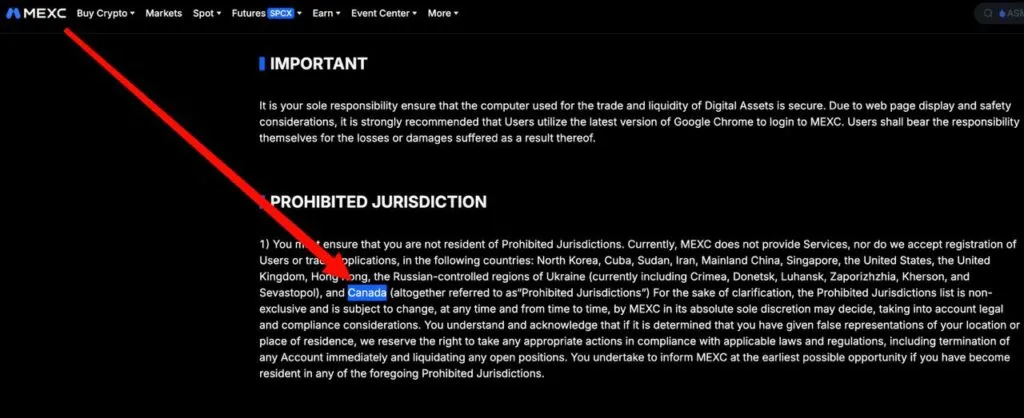
Officially, no. MEXC's User Agreement, last updated May 29, 2025, says it does not provide services, nor accept registration of users or trade applications, in a list of countries that includes Canada alongside the United States, the United Kingdom, Singapore and Hong Kong. MEXC holds no FINTRAC registration and is not authorized to solicit investors in any Canadian province. Regulators have said so publicly: the British Columbia Securities Commission issued an investment caution on August 23, 2023, the Nova Scotia Securities Commission lists it on its Investor Cautions List as of August 17, 2023, and the Ontario Securities Commission warned on May 30, 2025 that MEXC is not registered in Ontario to trade in securities.
Note that MEXC is not on the CSA's banned list, so "banned in Canada" would be inaccurate. It is simply prohibited by its own terms and unregistered. I want to be direct about what that means in practice, because the gap between the official position and what actually happens is wide.
The official position: MEXC's terms list Canada among prohibited jurisdictions. If you are a Canadian resident and sign up, you are agreeing to terms that say you are not supposed to be there. The reality: Canadians have used MEXC for years, mainly for altcoins that no regulated Canadian exchange carries. What that means for your risk: if something goes wrong with your account, you have no Canadian regulator to contact. The OSC cannot intervene on your behalf, and if MEXC freezes your funds and you technically agreed to terms saying you should not be on the platform, your recourse is very limited. That is the real risk, and it is worth naming plainly.
I cover MEXC honestly because many Canadians will look at it regardless, and an accurate picture is more useful than pretending it does not exist. If you want a fully registered alternative, see the best crypto exchanges for Canadians list.
Is MEXC Better Than Binance For Canadians?
It is the wrong question now, because Binance left Canada in May 2023. On paper MEXC has the bigger coin list and a spot fee of 0% maker and 0.05% taker. In practice both are the same kind of risk for a Canadian: no registration, no Canadian regulator to call. If you want coin variety with a regulator behind you, Kraken is the registered platform with the widest list on my ranking.
Is USDT Legal In Canada?
Owning USDT is not illegal, but registered Canadian platforms cannot offer it. Under CSA Staff Notice 21-333 a platform can list a stablecoin only if its issuer meets reserve and disclosure terms, and USDC is the one that committed. Coinbase and Crypto.com delisted USDT for Canadians in 2023. That has no bearing on MEXC's own terms, which still list Canada as prohibited.
How Can You Check That MEXC Is Registered?
Do not take my word for it. These are the official registers, with what they showed for MEXC when I checked them for this review.
| Register | Result | Verify |
|---|---|---|
| CSA list of authorized crypto platforms | Not listed | Check the CSA list |
| CIRO dealer member | No | Check CIRO’s list |
| FINTRAC money services business | No match for 'mexc' in the FINTRAC MSB registry open-data file. | Search FINTRAC’s registry |
Is MEXC Legit And Safe?
MEXC is a real, functioning exchange with real liquidity. It is not safe in the sense of being regulated or covered by Canadian consumer protections. It holds no recognized licence from a Canadian regulator, no CIRO membership and no FINTRAC registration, and it is based offshore.
On the security side, MEXC says it publishes proof-of-reserves audits and runs a protection fund, and it offers the standard account tools: two-factor authentication, anti-phishing codes, withdrawal address whitelisting and cold storage. I could not verify the current reserve figures or fund size on MEXC's own pages in October 2026, so I am not quoting any. Check the proof-of-reserves page itself before you rely on it.
The honest summary: MEXC is not a shell company. It is a large exchange with real infrastructure and security features. It is also offshore, unregistered in Canada and in a grey area for Canadian users. Those two things can both be true at the same time.
Can Canadians Trade On MEXC Without KYC?
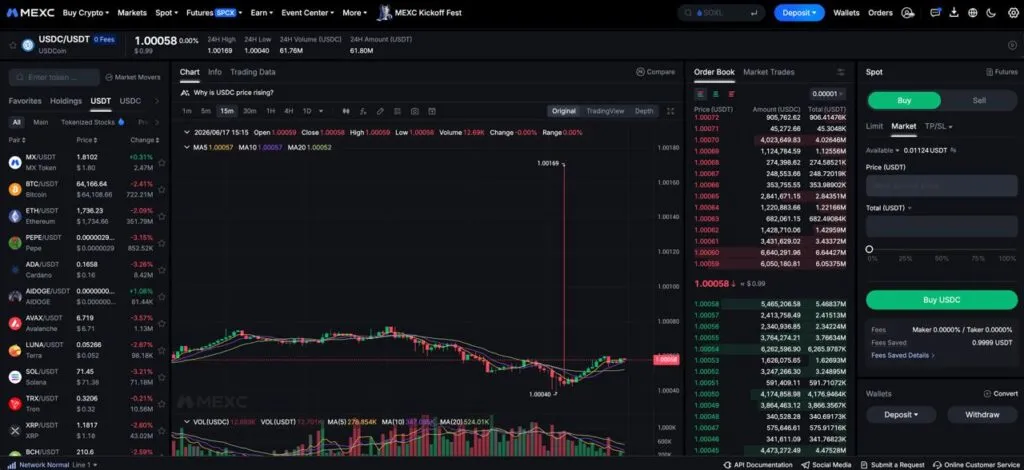
MEXC used to be one of the last major exchanges allowing meaningful trading without identity verification. That era ended. It now uses tiered verification: a basic tier with a government photo ID and a selfie with liveness detection, and an advanced tier that adds proof of address dated within 90 days. Limits and unlocked features change, so read the current ones in your account. Fiat on-ramps and token launch events need verification.
For a Canadian, that means handing government-issued documents to an unregulated offshore entity, which is a meaningful difference from submitting your ID to a CIRO-regulated dealer like Shakepay or NDAX. Some users on Reddit have reported being asked for KYC when they became profitable or tried to withdraw a large amount for the first time, which is a pattern worth knowing before you deposit. If you want trading without identity checks, look at my guide to no-KYC exchanges for Canadians.
What Is MEXC's History And Track Record In Canada?
MEXC began life in 2018 as MXC Exchange and was later rebranded as MEXC Global, according to my earlier research. Its Canadian regulatory trail is what matters here.
| Date | Event |
|---|---|
| 2023-08-17 | Nova Scotia Securities Commission lists MEXC on its Investor Cautions List |
| 2023-08-23 | BCSC issues an investment caution: MEXC accepts BC residents but is not recognized as an exchange or registered as a dealer in BC |
| 2025-05-29 | MEXC's User Agreement is last updated, naming Canada as a prohibited jurisdiction |
| 2025-05-30 | OSC investor warning: MEXC is not registered in Ontario to engage in the business of trading in securities |
How Do You Sign Up And Verify On MEXC?
Sign-up asks for only an email address or phone number and a password, and you will see a country selection field. This is where the official restriction sits: MEXC's terms prohibit Canadian residents from registering. Providing a Canadian address or ID at the KYC stage may trigger account restrictions or closure. The process itself takes minutes, and the compliance risk is the real consideration for Canadians.
- Create an account. Email or phone, plus a password.
- Basic verification. A government photo ID (passport, national ID card or driver's licence) plus a selfie with liveness detection. Review is typically automated.
- Advanced verification. Proof of address dated within 90 days, required for the highest limits and some launch events.
How Do You Add Funds To MEXC As A Canadian?
There is no Interac e-Transfer and no direct CAD deposit option, and with Canada a prohibited jurisdiction, I have no verified CAD funding route to report. What experienced Canadians reportedly do is buy BTC, ETH or USDT on a registered platform like NDAX or Newton and send it to a MEXC wallet address, since crypto deposits are free. Test with a small amount first. Third-party card providers cost more than that route, and peer-to-peer trading carries counterparty risk, so verify any counterparty carefully. None of this changes the fact that you would be using a platform whose terms exclude you. The funding experience is meaningfully less convenient than on regulated Canadian exchanges.
What Does MEXC Actually Cost?
MEXC's spot fees are among the lowest of any major exchange. The base rate is 0% maker and 0.05% taker, and paying with the MX token takes 20% off, for 0.04% taker. Some special pairs cost more. Crypto deposits are free, and withdrawal fees vary by coin and network, because MEXC passes the blockchain cost through. I could not verify a Bitcoin withdrawal fee, so I am not quoting one. Choosing a cheaper network, for example TRC20 for USDT rather than ERC20, usually cuts what you pay.
| Platform | Fee Rate | Fee On CAD 10,000 |
|---|---|---|
| MEXC maker | 0% | CAD 0 |
| MEXC taker | 0.05% | CAD 5 |
| NDAX | 0.20% flat | CAD 20 |
| Kraken Pro maker | 0.40% | CAD 40 |
| Kraken Pro taker | 0.80% | CAD 80 |
Those are fee rates only. Spreads, network withdrawal fees and any card-purchase fees come on top, and on a platform that does not take CAD, getting money in costs extra. See the best crypto exchanges ranking for the all-in comparison. Always check MEXC's official fee page before trading, since rates change.
What Features Does MEXC Offer?
MEXC is one of the most feature-heavy exchanges. It offers spot trading on 1,425 coins, futures, copy trading, a launchpad for early token access, staking and earn products, and demo trading. For Canadians, the early token listings are the primary draw, though futures and derivatives are not available to you under its terms.
Coin Selection And Early Listings
This is MEXC's single biggest differentiator. It carries assets that no regulated Canadian exchange will touch, and it often lists new projects before Binance, Coinbase and other major platforms. For Canadians interested in altcoin trading or early-stage projects, MEXC is often the only liquid option. That comes with real risk: many early-listed tokens drop sharply after the initial hype, and some projects fail outright.
Futures And Leverage
MEXC supports perpetual contracts with high leverage, and the 0% maker fee attracts high-frequency traders. I would not recommend high-leverage futures trading to anyone, Canadian or not. The combination of volatile tokens and extreme leverage wipes out accounts quickly, and derivatives are not offered to Canadians under MEXC's terms.
Copy Trading, Launchpad, Staking And MX
Copy trading lets you follow experienced traders, and MEXC takes a commission on the profits. Review a trader's track record carefully before following. The launchpad lets users join new token sales before public listing and needs advanced KYC, but many launchpad tokens spike at listing and then decline, so do not treat early listings as guaranteed gains. Staking and earn products carry rates that can fall after promotions end, so verify the current rate on the platform. The MX token is MEXC's native token and gives the fee discount noted above, but it has its own price risk.
Demo Trading, Airdrops And Everything Else
MEXC runs a demo mode for practising futures without real capital, regular airdrop campaigns and a hybrid on-chain trading section. All of it is built to keep active traders on the platform, and most of it is aimed at people chasing quick gains. I would treat these extras as optional and test each one with tiny amounts, because campaign rewards often come with conditions that are easy to miss.
What You Do Not Get
No Interac e-Transfer, no CAD wire, no direct bank integration and no Canadian customer protection. You also do not get a Canadian entity to complain to, a CIRO complaints process, or the segregated-client-asset rules that apply to registered dealers. The funding and cash-out experience is meaningfully less convenient than on any CSA-registered platform, and that inconvenience is part of the real cost of the low fees.
MEXC Versus BloFin
The closest like-for-like in my ranking is BloFin, another offshore exchange whose terms prohibit Canada. BloFin sits higher in my ranking at 9.6 against MEXC's 7.0, with a 0.1% spot fee and 235 spot assets, while MEXC has the lower taker fee and a much longer coin list. Both carry the same fundamental risk, so choose between them on the coins you want, not on the idea that one is safer.
How Does MEXC Compare To Other Exchanges Available To Canadians?
On fees and coin selection, nothing registered in Canada comes close. On regulatory protection, MEXC offers none. It is the right choice for altcoin access if you accept the regulatory and account risk, and the wrong choice if you want Canadian consumer protections.
| Exchange | Spot Fees | Coins | Canadian Status | CAD Funding |
|---|---|---|---|---|
| MEXC (7.0) | 0% maker / 0.05% taker | 1,400+ spot assets | Offshore, terms prohibit Canada | None verified |
| Kraken (9.2) | Pro 0.40% / 0.80% | About 490 | CSA-registered | Free Interac e-Transfer |
| NDAX (7.8) | 0.20% flat | 77 | CSA-registered, CIRO dealer | Free Interac e-Transfer and wire |
| BloFin (9.6) | 0.1% spot | 235 | Offshore, terms prohibit Canada | None |
| Coinbase (9.8) | Up to 1.875% on simple buys, plus spread | 200+ | CSA-registered | Free Interac e-Transfer and EFT |
What Are The Biggest Complaints About MEXC?
The dominant complaint pattern, far more than anything else, is accounts being frozen by "risk control" with no clear explanation, funds held for weeks or months, and template support responses that do not resolve the issue. For Canadian users that pattern is more dangerous, because there is no Canadian regulator to escalate to.
Risk Control Account Freezes
This is the single most consistent and serious complaint across review sites, Reddit and crypto forums. The pattern goes like this: a user trades normally for weeks or months, then becomes profitable or tries to make a large withdrawal. MEXC's automated risk control flags the account, the user gets a generic notice, and support replies with template messages. Some users wait days, others months. MEXC's terms give it broad discretion to freeze accounts for abnormal or automated trading, and "abnormal" is defined internally and not publicly documented.
This is not usually targeted theft, but it is a genuine operational risk. For Canadians the realistic options if your account is frozen are to wait, provide whatever documentation MEXC asks for, or pursue legal action in a foreign jurisdiction. That is a real problem.
KYC Requested At Withdrawal
Several documented cases show users depositing and trading freely, then being asked for KYC only when they try to withdraw. For a Canadian who agreed to terms saying they should not be on the platform, completing KYC to reach your money may itself trigger a review based on prohibited-country status. Test with small amounts before depositing anything significant.
Futures Delistings And Early Token Risk
MEXC has been documented delisting perpetual futures contracts mid-trading and forcing settlement at prices that caused losses, with no compensation, under its position that forced settlement is market risk. And many tokens listed early are memecoins or low-liquidity projects with extreme volatility. The sheer volume of speculative listings makes MEXC a higher-risk environment than exchanges with selective listing standards.
How Is MEXC's Customer Support?
MEXC offers 24/7 live chat, email ticketing and a help centre, with no phone support. I have tested MEXC's live chat for routine fee and feature questions. The responses are reasonably fast and the agents are knowledgeable on standard topics. The experience degrades sharply when the issue is account-level. Users dealing with risk control freezes consistently report receiving the same template response regardless of what specific question they ask. For anything involving frozen funds or disputed account actions, support is unreliable, and for Canadians, who have no national-level consumer body for crypto disputes, that is one of the most significant practical concerns.
The apps score well: Apple Canada shows 4.74 from 1,908 ratings, and Google Play shows 4.6 from 313K reviews globally.
How Do You Withdraw And Cash Out From MEXC?
MEXC does not support CAD withdrawals, so cashing out means withdrawing crypto. The usual route is to trade your position into a stablecoin like USDC or USDT, withdraw it on a cheap network to an account at a registered Canadian platform such as NDAX, sell it for CAD there and send the CAD to your bank by Interac e-Transfer or wire. Every hop has a cost: the MEXC network withdrawal fee, the Canadian platform's trading fee or spread and sometimes a bank fee, so work out the total before you move size.
Always send a small test amount first and double-check the network and address. A coin sent on the wrong network is usually gone for good, and no Canadian regulator can help you recover it. If you are not comfortable with that, MEXC is not for you.
What Should You Do Before Depositing On MEXC?
Treat MEXC as a trading venue, never as a bank or a wallet. These rules are the ones I follow with any offshore platform:
- Read the current terms yourself. They changed in May 2025, and they can change again.
- Deposit only what you can afford to lose access to. Account freezes can last for weeks or months, and you will have no regulator to call.
- Keep long-term holdings off the exchange. Move coins you are not actively trading to a hardware wallet. See the best crypto wallets for Canadians.
- Turn on every security setting. Two-factor authentication, an anti-phishing code and a withdrawal address whitelist cost nothing.
- Keep your own records. Download your trade and transfer history regularly, because you may not get it back from a frozen account.
- Never trust unsolicited help. Anyone who contacts you first offering to unfreeze funds is a scammer. Our guide to common crypto scams in Canada shows the usual scripts.
How Is Crypto Traded On MEXC Taxed In Canada?
The CRA treats crypto as a commodity, so each trade, including swapping one coin for another, is a disposition you have to report, either as business income or as a capital gain depending on how you trade. Using an offshore exchange does not change that. Active spot and futures traders on MEXC can generate hundreds of dispositions in a month, and MEXC will not hand you a Canadian tax slip, so keep your own records or use a crypto tax tool.
Why Do Canadians Keep Using MEXC Anyway?
Because the product is good at the one thing registered Canadian platforms are not. Kraken lists about 490 assets and NDAX 77, while MEXC lists around 1,425 on spot, with new tokens often appearing there first. The fees are lower than almost anything else I have tested. And for a trader who has already been burned by wide spreads on simple-buy apps, a 0% maker fee is a strong pull.
My advice is to be honest with yourself about which side of the line you are on. If you want one or two small-cap altcoins, a few hundred dollars and a clear exit plan, the risk is contained. If you want a place to park savings, a registered exchange is the right answer. Start with the best crypto exchanges in Canada list or the exchange quiz.
Who Should Use MEXC, And Who Should Not?
MEXC makes sense for experienced Canadian crypto traders who specifically need altcoins and early listings unavailable on registered platforms, and who understand they are using an unregulated offshore exchange. It is not suitable for beginners, for anyone who needs Interac deposits, or for anyone who cannot afford a funds dispute with no regulator to call.
MEXC May Be Worth Considering If You
- Have been in crypto long enough to understand offshore exchange risk
- Specifically need altcoins or early-stage tokens not listed on any registered Canadian platform
- Already hold USDT or BTC elsewhere and can move it by crypto transfer
- Would only deposit what you are prepared to lose access to in a dispute
MEXC Is Not Right For You If
- You are new to crypto. Start with a registered platform, such as Coinbase or Kraken
- You want to deposit CAD by Interac. Use NDAX or Newton
- You need Canadian regulatory protection if something goes wrong
- You plan to deposit a large part of your savings. No exchange is worth that risk without a regulator behind it
- You want staking, altcoins and regulation together. Wealthsimple Crypto and NDAX handle that on Canadian soil
MEXC: Best Offshore Pick For Small-Cap Altcoins
7.0/10Best for: experienced traders hunting small-cap altcoins
Offshore Not registered with the Canadian Securities Administrators, and its terms of service restrict Canadian residents. No Canadian investor protection applies. It suits only experienced traders who can afford to lose access to the funds.
- Fees0% maker / 0.05% taker on spot
- CAD FundingNone verified
- Coins1,400+ spot assets
- BonusSign-up bonus not applicable to Canadians
Pros
- 0% maker spot fee, among the lowest anywhere
- 1,400+ coins, including early listings
- Copy trading, staking and launchpad in one place
- Strongly rated apps
Cons
- Canada is a prohibited jurisdiction in its terms
- No CSA, CIRO or FINTRAC registration
- Regulator warnings in BC, Nova Scotia and Ontario
- No Interac or CAD deposits
- Risk control freezes with no regulator to call
Is MEXC Worth It For Canadians?
MEXC is a genuinely impressive exchange on features and fees. The 0% maker spot rate, the huge coin selection and the early listings are real. If you live somewhere MEXC is fully available, it is one of the best platforms in the world for active traders.
For Canadians, the picture is different. You are officially restricted by the terms you agree to at sign-up. Regulators in BC, Nova Scotia and Ontario have warned against the platform. There is no FINTRAC registration, no CIRO oversight and no Canadian consumer protection framework if your account gets frozen. I have reviewed over 60 exchanges since 2016, and the frozen-at-withdrawal pattern is not unique to MEXC, but the consistency of it in MEXC's reviews is worth taking seriously.
My recommendation: if you are an experienced trader who specifically needs what MEXC offers, use it with your eyes open, fund it by crypto transfer from a registered platform rather than putting money directly onto the exchange, and never deposit more than you are prepared to fight to get back. If you just want low fees on popular coins, NDAX at 0.20% flat is a registered alternative. Compare everything in the best crypto exchanges in Canada list.
What Changed For MEXC In October 2026?
- The Ontario Securities Commission warned that MEXC is not registered in Ontario to trade in securities.
- MEXC updated its User Agreement and names Canada as a prohibited jurisdiction.
- The BCSC issued an investment caution for MEXC.
- The Nova Scotia Securities Commission added MEXC to its Investor Cautions List.
Where Do These Facts Come From?
Fees, coin counts, registrations and ratings in this review were checked against these official pages and registers:
- mexc.com/terms
- securities-administrators.ca/crypto-platforms-regulation-and-enforcement-actions/crypto-pl
- securities-administrators.ca/crypto-platforms-regulation-and-enforcement-actions/banned-cr
- ciro.ca/office-investor/dealers-we-regulate
- fintrac-canafe.canada.ca/msb-esm/reg-eng.xlsx
- mexc.com/fee
- api.mexc.com/api/v3/exchangeInfo
- apps.apple.com/ca/app/id1605393003
- play.google.com/store/apps/details?id=com.mexcpro.client&hl=en_CA&gl=CA
How I test and score exchanges: my methodology.
Frequently Asked Questions
Is MEXC Legal And Available In Canada?
Officially no. MEXC's User Agreement, last updated May 29, 2025, names Canada as a prohibited jurisdiction. It holds no FINTRAC registration and is not on the CSA's authorized list. It is also not on the CSA banned list, so it is unregistered and prohibited by its own terms rather than banned.
Has Any Canadian Regulator Warned About MEXC?
Yes. The BCSC issued an investment caution on August 23, 2023, the Nova Scotia Securities Commission lists it on its Investor Cautions List as of August 17, 2023, and the OSC warned on May 30, 2025 that MEXC is not registered in Ontario.
What Are MEXC's Fees?
On spot, 0% maker and 0.05% taker, with a 20% discount when paying fees in MX. Futures maker is 0%. Crypto deposits are free and withdrawal fees vary by network. Check the official fee page before trading.
Can Canadians Use MEXC Without KYC?
Basic trading can start with little information, but fiat on-ramps, token launch events and larger withdrawals need verification, and users report KYC requests at the first large withdrawal. Do not rely on no-KYC access.
How Do You Fund A MEXC Account In Canada?
There is no Interac e-Transfer and no direct CAD deposit. Crypto sent from a registered exchange is the usual route, but using MEXC at all conflicts with its terms for Canadians.
What Is The Best Registered Alternative To MEXC?
Kraken has the widest registered selection, about 490 assets, with free Interac e-Transfer deposits. NDAX has a flat 0.20% fee and 77 assets.
Can You Withdraw Money From MEXC In Canada?
Not in Canadian dollars. MEXC does not support CAD withdrawals, so you withdraw crypto to an account at a registered Canadian platform, sell it for CAD there and send the CAD to your bank. Each hop has a fee, so total it before you move size, and send a small test amount first.
Is MEXC Better Than Binance For Canadians?
Binance left Canada in May 2023, so it is not an option. MEXC has a far larger coin list (about 1,425 spot assets) and a 0% maker, 0.05% taker spot fee, but its terms prohibit Canada and no Canadian regulator stands behind it. A registered platform such as Kraken is the safer comparison.